I don’t know just how long it will take me to not remember: the routes, the routines, the smallest of ingrained gestures—like reaching for my coffee-change pouch last minute, before setting out on my Sunday wanders into the Altadena foothills.
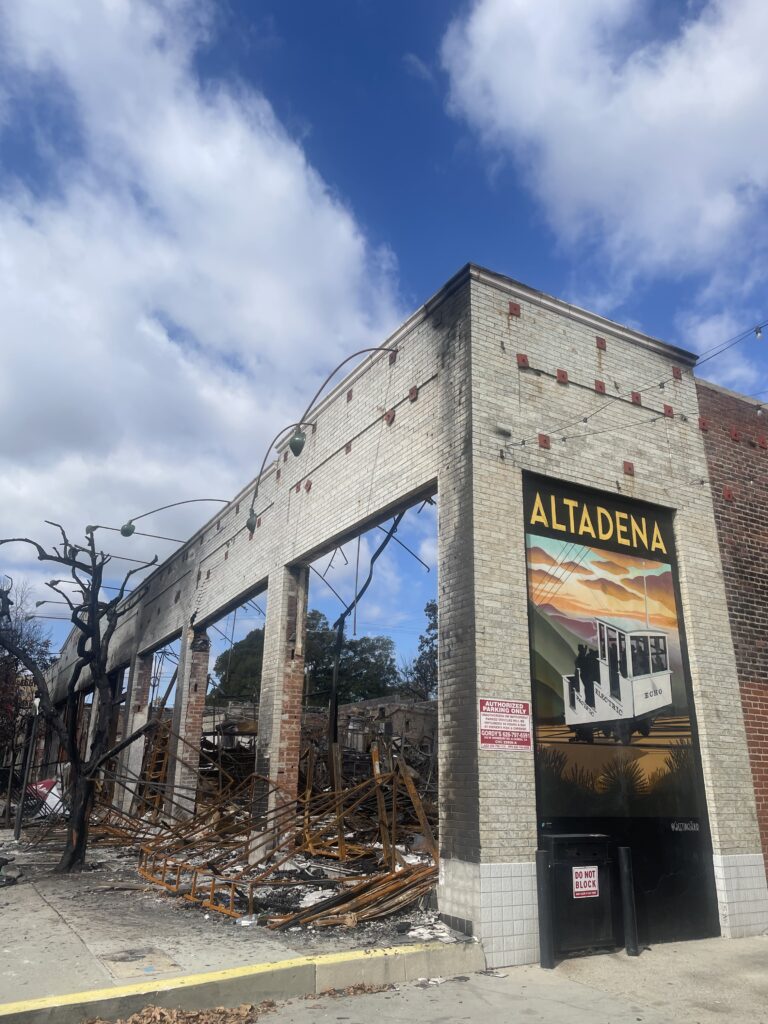
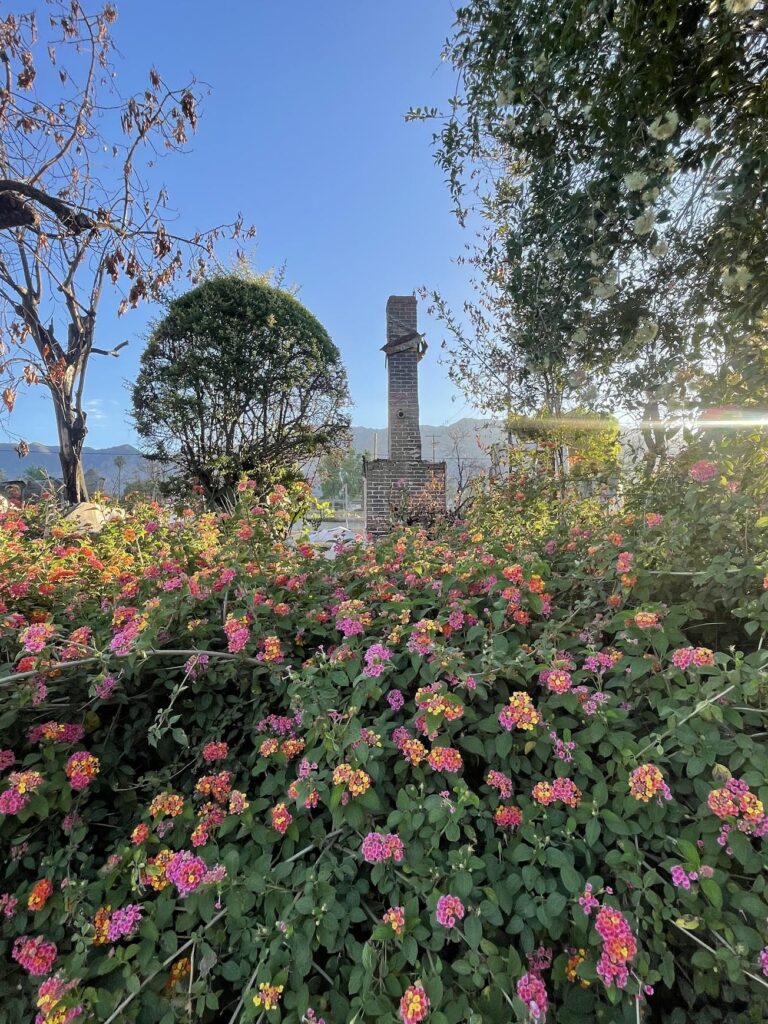
That sweet little cafe, with its tranquil just-beginning-to-mature native garden, is gone. So is the diner where I sometimes directed out-of-town guests searching for something “typical of the neighborhood.” Add to it: the “lower-key” grocer. The post office. The florist. And too, the ninety-year-old, grand WPA-era building where I had only recently cast my ballot. All ashes, rubble, or a singed-yet-standing carcass of what once was.
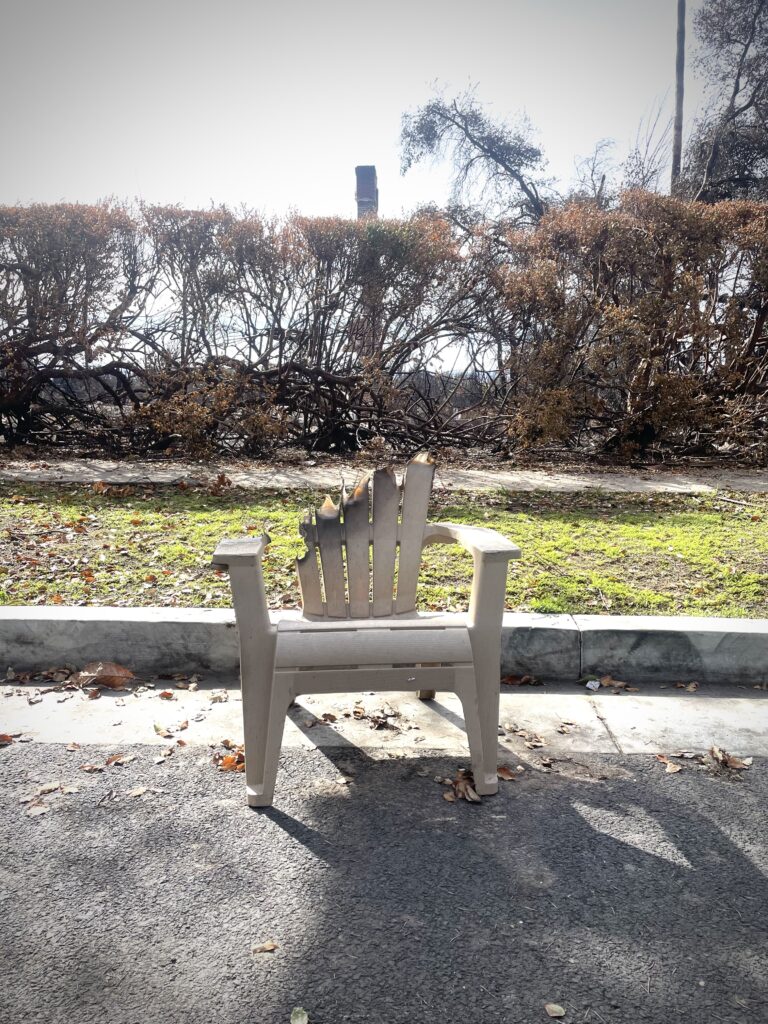
I reached for that pouch only last Sunday, just as I have too many other Sundays over this past year, then sharply scolded myself. I suspect that impulse will continue until it ceases. Muscle memory, well-entrenched.
A year and six months in, it still doesn’t take much to trip an emotional wire, given an entire sweep of the familiar has become unrecognizable: it’s both bewildering and exhausting to walk a blank slate.
****
I reside at the very northwest edge of Pasadena, so far north that one of my neighbors refers to it as “Baja Alta.” He’d been testifying, “Not a Pasadena guy,” long before the Eaton Fire tore through our community in January 2025. The declaration wasn’t meant as disdain. It was a clarification: Altadena, he explained, seemed to hold something of himself he was still trying to reach. “I almost got there.” Now, he’s of mixed feelings and many minds. If it’s gone at present, will it even be possible later? (For my neighbor, what will it now mean to be an “Altadena guy”?)
His house and mine still stand (the fire was contained three blocks away), but the neighborhood is forever changed. We all are too. After all this time, many in my multigenerational Baja Alta/Altadena community are slipping into new life phases—relocation, repair, rebuilding, rethinking. And while the scope of the devastation still boggles, we have come to realize that the loss isn’t just the blank space where the physical once stood, but the wake of memories attached to them. “First house.” “First Christmas.” “First kiss.”
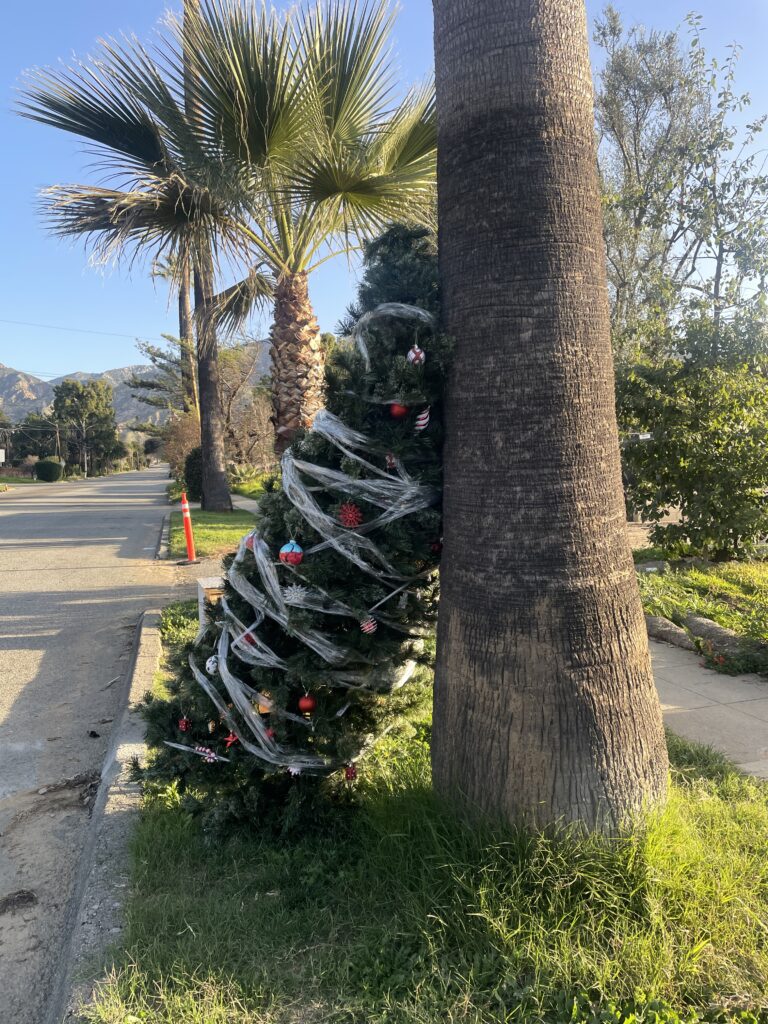
Some have pacified themselves by calling up old views on Google Maps (years, months. and days before the fire) and screengrabbing images of their entryway, garden, or vehicles lost to flames. Others have reached out to local artists to ask if they might be able to send along a photo of their old family home memorialized in a painting. Among the most affecting communal displays I observed over the 2025 holiday season was one of residents sharing photos online of their emptied lots (in various iterations of clearing, holding pattern, or rebuilding), with fully decorated Christmas trees standing in the place they would have traditionally occupied, if the house were still standing.
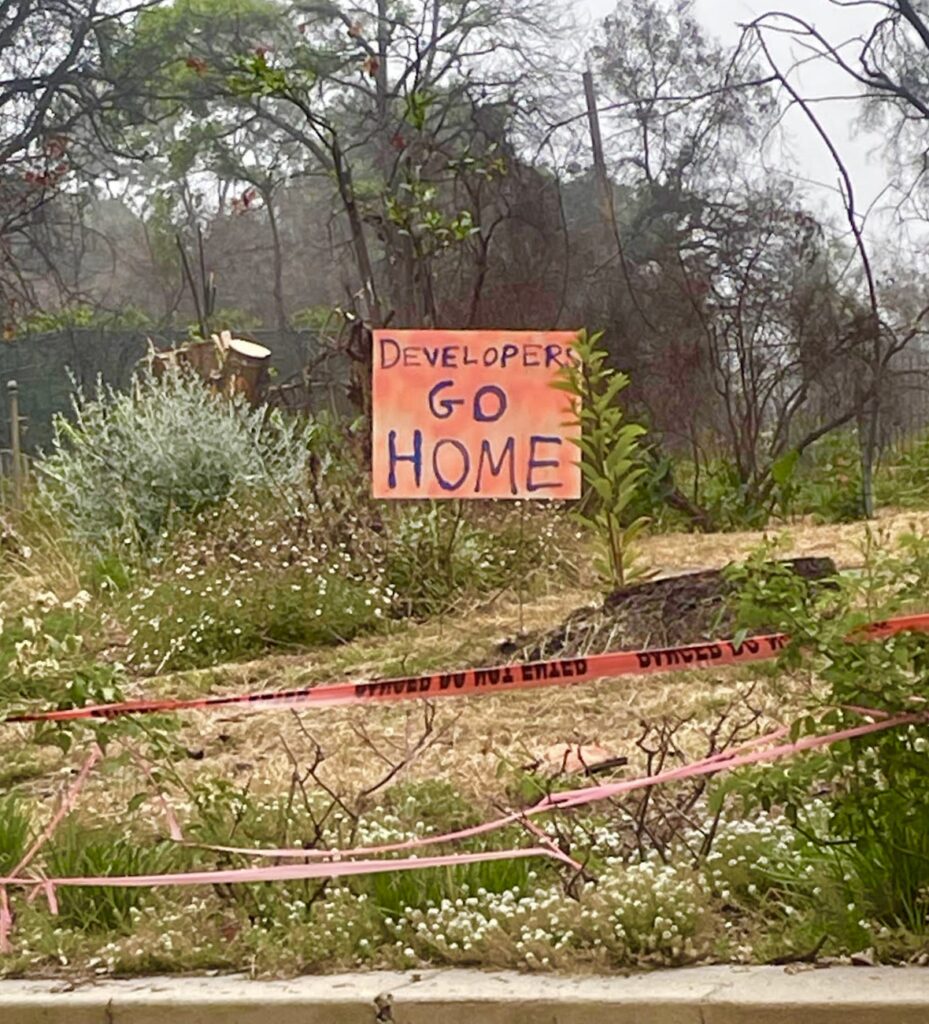
We are well accustomed to all manner of disasters here in California. Not inured precisely, but aware that it is ever an around-the-corner possibility. The Eaton Fire’s erasure, frankly, felt like something beyond our ken. A vivid, centuries-old, and idiosyncratic community destroyed at the root overnight: Suddenly past tense. Suddenly memory. It’s been a realization that has come both in waves and stages.
****
Unlike my neighbor, I didn’t move to “Baja Alta” to edge closer to myself. While I had spent time in the area, drawn by the nature—the trails that rose into the Angeles National Forest, the beguiling pink-purple tint of the San Gabriel Mountains, especially in fall and winter—I was intent on remaining in Echo Park, where I had lived for fifteen years, midway up a steep hill that granted me a filmic, establishing shot view of my native city. This idyll in the midst of urban sprawl made me feel I had indeed located something of myself. And while at the time it seemed solid and in my grasp, as it often happens in Los Angeles, bit by bit, I would note small alterations, elisions, until the meaningful familiar began to drift away.
I lived on that hill the year the Northridge earthquake jolted us. I was shocked awake by its sensational force—a thrust that felt like an enormous hammer striking the earth, followed by a runaway train charging underneath me. When the sun rose, I was amazed to see the damage wasn’t worse—although it was indeed dire—a collapsed freeway, dingbat apartment buildings that seemed to have melted into themselves, avenues with building after building “red-tagged,” announcing their not-safe-to-occupy status for all to see. For weeks, I felt the rumble-roll of aftershocks, even when there were none. The ground was uncertain. So was I.
What struck me, though, in the following tense weeks and months, was that even with the patches of destruction, the neighborhood held onto its sense of self in sensation, mood, and pace. Not too long afterward, however, what began to alter Echo Park in a more discernable and essential way was the pull of time, of “redevelopment,” of real estate booms and speculators—a steady wave of gentrification.
With it, the little things that had been key to the atmosphere of place, the whispers of our environment, began to fade—the wafting notes of mariachis strolling the boulevard late night, the roosters joining in just before sunrise, the wash of colors—pastel-hued bungalows, vivid handpainted storefront signage, the scent of hot oil and fish and garlic. For a time, we hovered in a middle space place—waiting for what would next define it. (In Echo Park’s case: Shaggy guitars, charcoal-hued California Craftsmans, twee crossed X logos, artisanal coffee.) Like so much that defined my experience here in Los Angeles, I knew to be prepared for come what may.
****
For decades now, I’ve been watching my physical sense of place, here in Greater Los Angeles, recede, as if desaturating in the astringent sun: slowly yet measurably. But when the day dawned in Altadena on January 8, 2025, what lay before us knocked us off our axis. We awoke to a stark, new landscape. Not just displaced, but disoriented. This was an entirely different category of natural disaster. The devastation was as abrupt as it felt thorough: An old way of life collapsed onto itself, for blocks and blocks and blocks, the destruction calculated at over 14,000 acres.
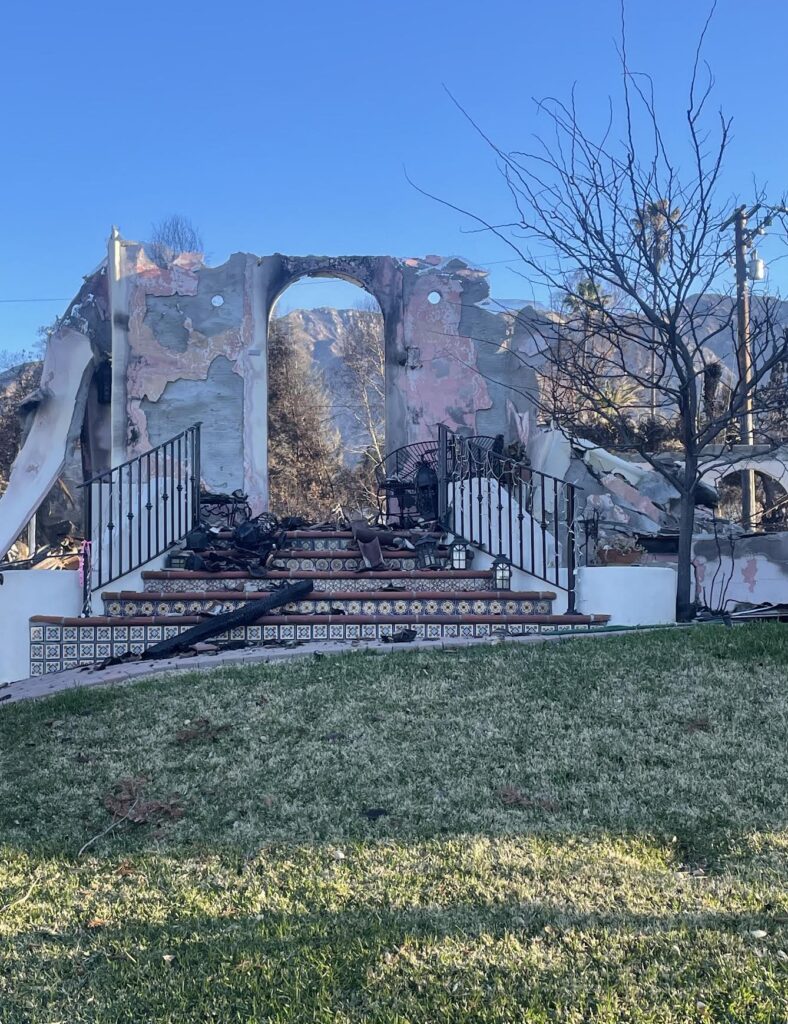
So much had been demolished —the physical anchors that helped situate you, that were your historic grounding and your context, the memories that you could point to.
Not even traces left.
****
We talk a lot about rebuilding—our conversations focused on weather-hardening homes, reseeding landscapes—but what will it take to rebuild ourselves? Moving forward, it’s become clear that the recovery challenge is two-fold.
Late spring, reports began to emerge with more alarming findings, some warning that the worst is not necessarily behind us: Wildfire survivors, mental health experts note, are subject to a markedly higher risk of depression, anxiety, and suicidal ideation—that emerges during year two of recovery. For us, that would be at the turn of the new year, now moments away.
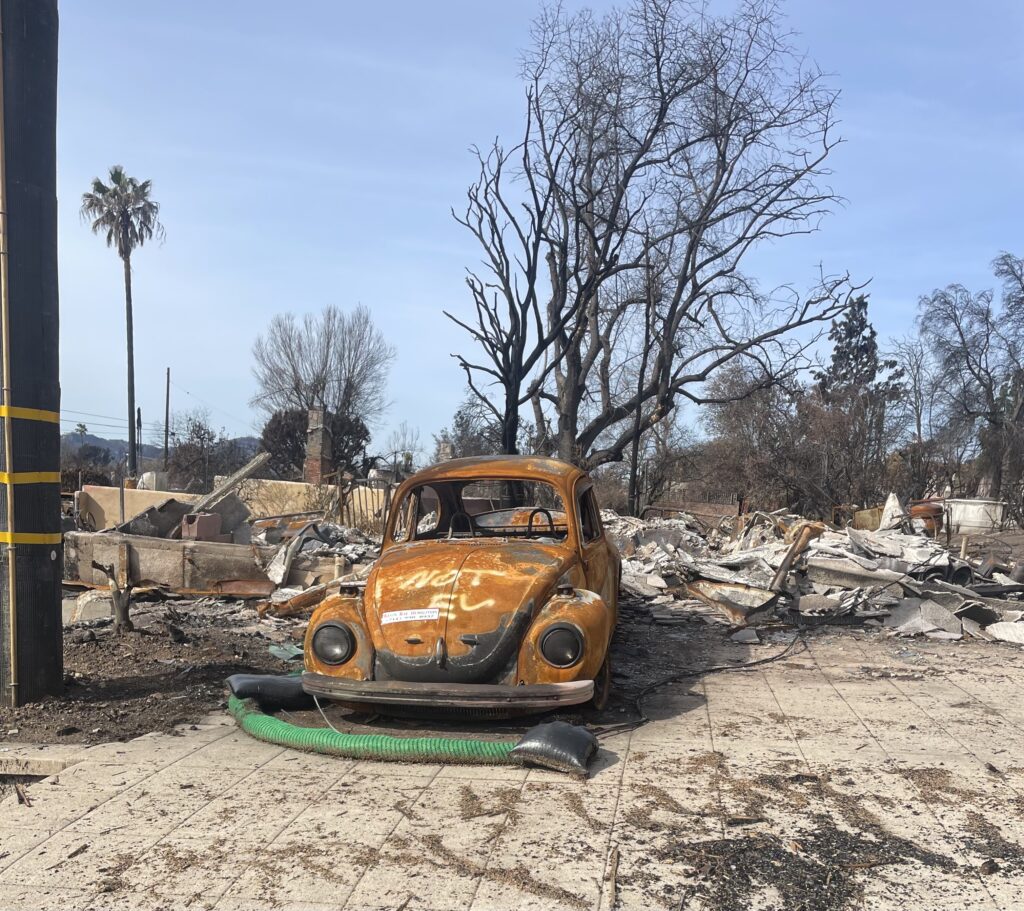
We’ve subsisted on tenterhooks for quite a while.
In the fire’s early aftermath, I began stitching in extra time. As I went about my neighborhood errands, I wanted to leave space for the random exchange: Small talk isn’t “small” any longer here. It’s open-ended, looping and confessional. Consequently, I’ve spent a year all ears, listening to residents—current, past, and future. I have absorbed their stories about racing coyote packs overtaking the once populated city blocks, about the neighbor who ignored evacuation orders and hid out to care for his exotic birds, about the new scatter of works of art that have risen from the debris. People tell me what they miss most—“The late-night calls of great horned owls.” What pulled them here—“The reach of the mountains.” How it made them feel—“Free.” All the stories, wildly personal evocations that embody the heart of what defines home: the embroidered details we root around for, “typical of the neighborhood.”
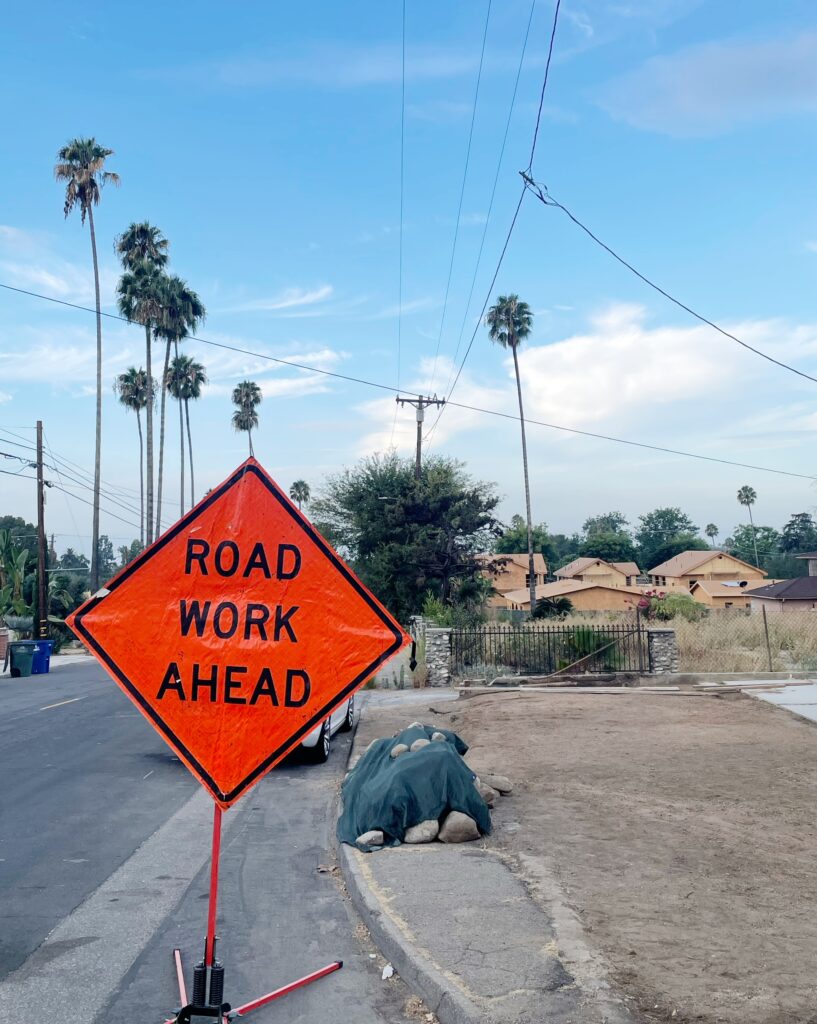
In time, these witnessings and commemorations will be among the new stories I—and we—will tell about Altadena, to add to those that came before: What we saw, with whom we interacted, what made us feel that we found “our place”—sturdy and definable.
Disaster halts, then reroutes, personal narrative: the story of self we were writing, the goals we were striving to reach, inspired by, or associated with, that specific place. The equivalent, however, is not true in quite the same way; the landscape may be transformed, but the story presses onward with or without you.
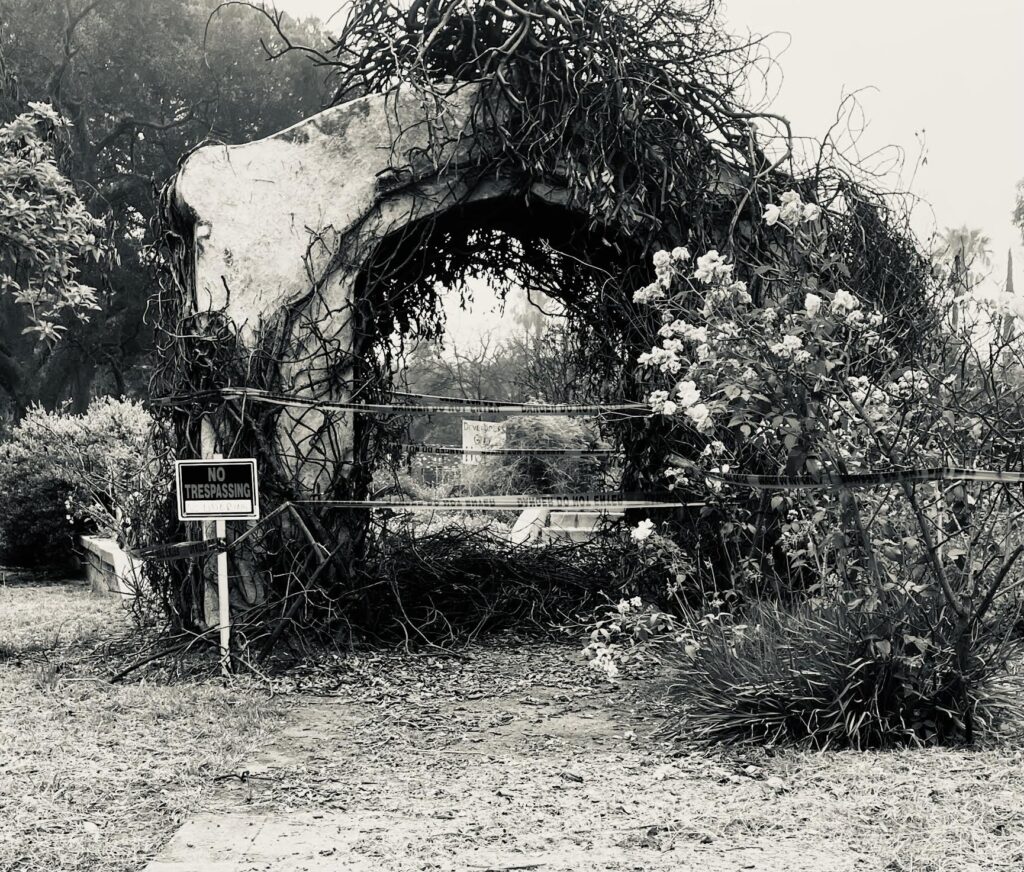
We float in hang time—within the abrupt, choppy transition between what was and what’s not promised.
For those who can’t or won’t return, who aren’t able to pick up their story thread, what happens to those stitches of memory or ritual—the mood, ambiance, or touchstones of place? Will the land remember that “you were here?” My entire being holds on to what’s been ingrained. My patterns. My paths. My expectations. It’s vital for those of us who remain and remember to bridge past and present, to restore and preserve a sense of coherence of community for the future, to make sure that, even if it might very much look like it, all is not lost.
(March–June 2026)