Editor’s Note: We are thrilled to publish an excerpt from Memory Rehearsal by Eleni Sikelianos, newly released from City Lights Books. In 1901, Eva Palmer abandoned her life as a privileged New York socialite, moving to Paris with her lover, the writer, and salonist, Natalie Barney. The two Americans became the center of a wild tangle of lesbian love affairs and backyard performances based in an intentional reimagining of Sappho’s work and life. This hotbed of early European modernism saw in the ancient past the possibility for sexual and artistic emancipation, especially for lesbian women.
A chance encounter led Eva to Greece, where she married Angelos Sikelianos, a visionary poet who would become a Greek national hero. Together, they decided to stage a revival of the ancient Delphic festivals, convinced that it would open a path to world peace. By the end of two festivals, their meticulous reproductions had managed to change the course of modern Greek cultural history, even as their marriage dissolved. Eva returned to the U.S. and spent the next decades of her life in debt, but she never stopped pursuing her vision, convinced of the revolution of consciousness these art festivals could bring about.
Celebrated American poet Eleni Sikelianos grew up knowing little of her illustrious ancestors, and it was not until the age of 20, on her first trip to Greece, that she encountered the breadth of their legacy. In Memory Rehearsal, Sikelianos unearths the story of her pioneering ancestor trying to make a place for herself, in a text that shifts between prose, poetry, imaginary performance texts, fiction, and nonfiction, with archival and family photographs.
**We have reproduced the intentional spacing in the original work to the best of our ability.
and she dressed her baby in ancient gowns
*
The Child
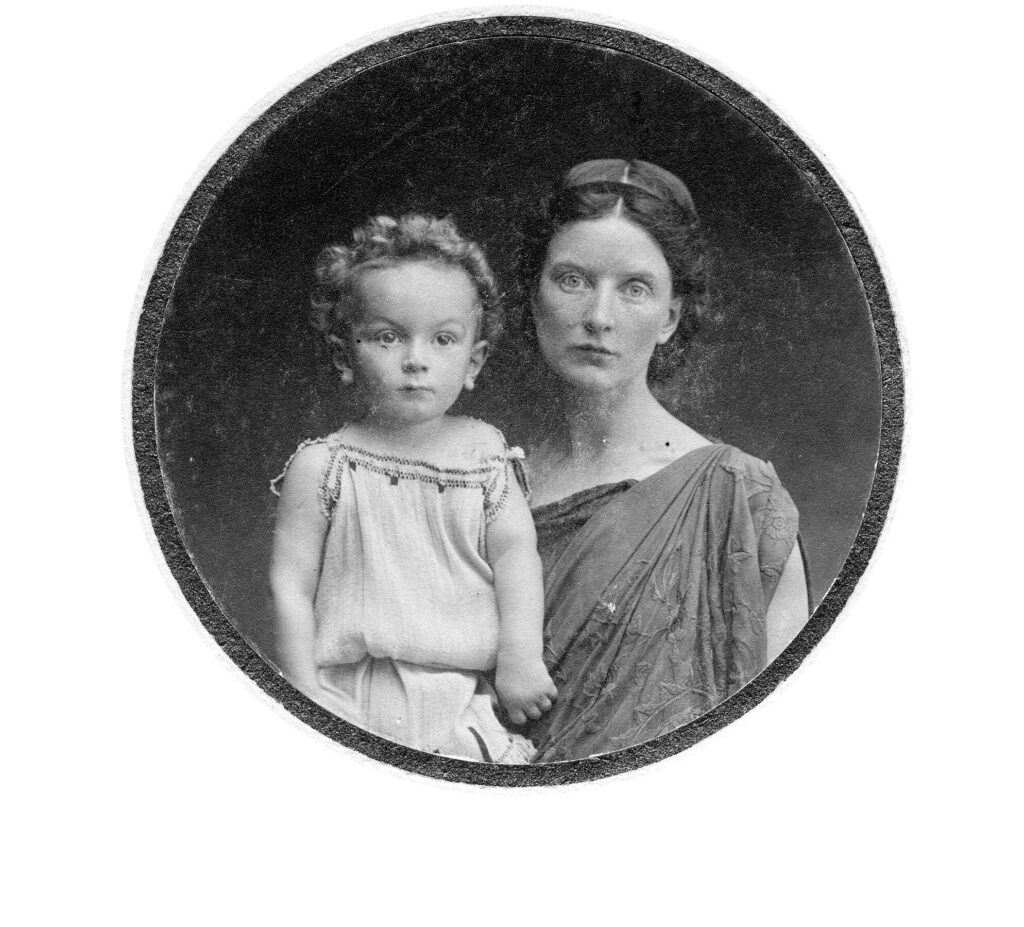
The child in the picture is my grandfather, Glaukos. He is an old man in every memory I have of him, but he too was once young.
His fingers curled into his mother’s new-woven ancient chiton, rootlets softly seeking their nourishing ground. The world is a strange place. His mother may have dropped in on it from elsewhere, or is preparing for there. If I read her face right, she is already listening to some other realm, where the winds roam and whistle over vast shapes.
I have been invited to look again into their eyes: into the fresh-time of the child, the all-time of the aspiring visionary who has recently been startled into the experience of having a child rush into bloody life from between her legs. They are gazing from two temporal zones, at angles all their own, but the baby’s gently groping fingers reveal how the roots touch and twine. His fingers are the devoted anchor, showing us that everything is connected, and that all times, at any moment, might still rise to life.
I look again, trying to cast myself into the picture, my mind bumping into the glass that frames it (that first time I saw it in the Sikelianos museum in Delphi), until I recognize that this history doesn’t yet include me. I keep coming back to the photo, trying to catch my great grandmother’s attention, or mine. It’s not an image where we’ve caught her in the act of her daily affairs, or where she is pretending to be engaged in such acts. It’s a different theater, and I am not allowed onstage. She herself half looks like she’s not quite sure why she’s there.
*
Still, every visionary has her blind spot.
*
But what if the rocks spoke?
Deeds accrue around me, events rush past. The accumulation of wrongdoing is vast. Bee-killing neonicotinoids and nuclear waste. Do I feel more a part of animal or mineral time?
My great grandmother hauled forward a past that she felt would allow her to exist in the present. When that didn’t work she erased her present-self from the records so that a future daughter of time would struggle to find her.
The archives are closed.
The stones are silent through the night.
*
And left wondering about how time’s mechanism sets into motion the two arms dangling from their sockets or undulating in air above her head. And how or if time keeps moving once when the arms stop.
*
The Old Man
As an old man, Glafkos lived with his girlfriend in an Airstream trailer up on Mountain Drive, where a friend let them park in a hollow shaded by eucalyptus trees. In those days Santa Barbara was still a town with a skid row and down-and-out drunks, a tortilla factory on Haley Street, bohemians, and, always, Chumash ancestral grounds. I called him by his name, would never have dreamed of saying “Grandpa,” an epithet that implies some kind of ownership. He didn’t believe in owning much, but he loved thinking about boats and how to build them. He always had a little workshop, which was sometimes just a couple of sawhorses outside the trailer, and he was always working on a skiff.
He walked long miles every day, frequently into town to pass out Peace and Justice leaflets in front of the art museum on State Street: U.S. out of El Salvador! Nuclear Disarmament Now! Some of my early memories are of his khaki-clad back while he walked far ahead of me on a leafy road.
Dead seal on a beach. Poked it with a stick. Glaukos moving on.
Or Glaukos with the stick pointing to some pompano bones. He’d caught them shore-fishing, built a little fire, and grilled them right on the beach. See, see how the vertebrae help the whole thing bend, and the strut bones support the fins? A boat should be built like that.
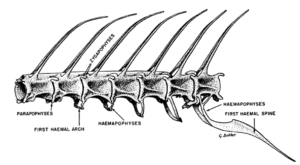
That was the most he ever talked.
What was his sense of time, I ask Gabriella, wondering if he was always as late or as absent as my father. His sense of time? she repeats, perplexed. He was either there or he wasn’t.
We lived together when I was a baby. Not with my father, his son, who was off drinking and doing heroin and running around the country, but with my mother, who, at 23, was in her own long, slow recovery from life. We lived together, without my father, in a burned-out adobe where everything was half-burned or half-built. The neighbor constructed an outhouse with a view of the islands out in the channel, and we took our showers in an unfinished pool with wine bottles cemented into the walls. We — my mother and I — were not the rich bohemians who inherited property after the long haul of living in communes or close to the land. We were the broke ones, squatting, the ones on food stamps without secret income. An early memory: kaleidoscopic sunlight filtering through green and amber and blue glass-bottle bottoms.
My mother likes to tell the story of Glaukos building me a huge outdoor pen from wood scraps so that I couldn’t wander too far, but I immediately toddled to the barrier, shook the bars, and howled. He was impressed that my first concern was with freedom.
Why am I sad writing this? You see the shape of the human you thought you’d be like a ghost in front of you.
You thought the whole world would be liberated one day.
Other mother stories. I liked to waddle to Glaukos’s door, bang on it with my open palms till he’d come out and say, Beaty (his nickname for me, in his Greek accent) — Beaty, you come for comestibles? And he would hand me things to try, often enough an onion, which I ate raw. He was raised (if you could call it that) to test the world for himself and that’s how he raised others. Thus, my uncle famously tried to drill his cousin Gabriella’s eye through a hole in the wall when they were seven. And I was left to touch the fire to figure out not to do that again.
Walking. Years later, in Sykiá, old Lefteris told me that he was crossing the canal one day in his truck when he saw an old man, and although it was from the back and he hadn’t seen him in forty years, he knew it was Glaukos by his gait. Also, how Glaukos had tied a balloon to his son, Brastias, so that he could keep track of him in the field. Brastias rose up into the air… Or so Lefteris said.
(Love does this making, of mythologies around ordinary humans.)
I have always wanted to hike farther than I am able. I have gotten lost at dusk, been stuck in deep canyons, taken the wrong fork, been chased in the dark by mama boars. Once, when I was walking on Mountain Drive, I encountered a woman who wanted to know this and that about me. When I said, “My grandfather lives down there,” and pointed into the hollow, she cried, “Glaukos?” and rushed toward me for a hug.
MJ, his girlfriend, said he was described to her before she met him as, “Well, like Jesus, but not religious. And less talkative.”
Though he liked to have good comestibles, not just onions, for people who stopped by the trailer — a nice whiskey, biscuits, nuts, dates — at times it seemed painful for him to speak.
In Greek, the ypsilon (υ) of his name, Glaukos, makes an “f” sound against the kappa (κ). In English the unseen “f” is silent unless we write it. In the huge tome of Glafkos’s father’s published letters, he only mentions that he has a child once. As if the “f” of “father” stayed silent in the father’s mind.
There were many Glaukoi in ancient Greece, all of them associated with the sea. In some, he is a ghost-deity who roams every single shore and island of the known world, accompanied by the silent monsters of the waters — a time-consuming tour that must start again as soon as the final coast has been visited. Our Glafkos was in the merchant marines for a time and like his mother had sea-green eyes.
He left school at seven, after he saw the headmaster beat a boy. No, he said, no I won’t go to such a school, and his mother, who taught herself much of what she knew, agreed. In his forties, staying with his ex-wife Frances in New York, he once returned to her house on MacDougal Street bloodied and beaten. He’d joined the fight with a Chinese immigrant who’d been jumped, presumably for being an immigrant. Later, an article called him “a radical pacifist-anarchist.”
It’s not the shape of a self you thought you’d become that’s making me sad. It’s the shape of the world that didn’t come clean.
When I came back from my first travels to Greece and beyond, I would sometimes ride my bike up the steep hill to his trailer and sit outside with him or at the little table inside. He’d had a stroke while I was away. It’s hard to imagine him using the word “I” but what else could he use?
I was lying on the bench (pats the seat). Something vacated the limbs, a mind, a spirit or bird hovering over the body. I got scared, and I came back with a little thud. Ah. (pause) In the middle of the final revolution, I got scared.
He was relating dying to the overthrow of power.
Then he said: I can’t wait to try it again.
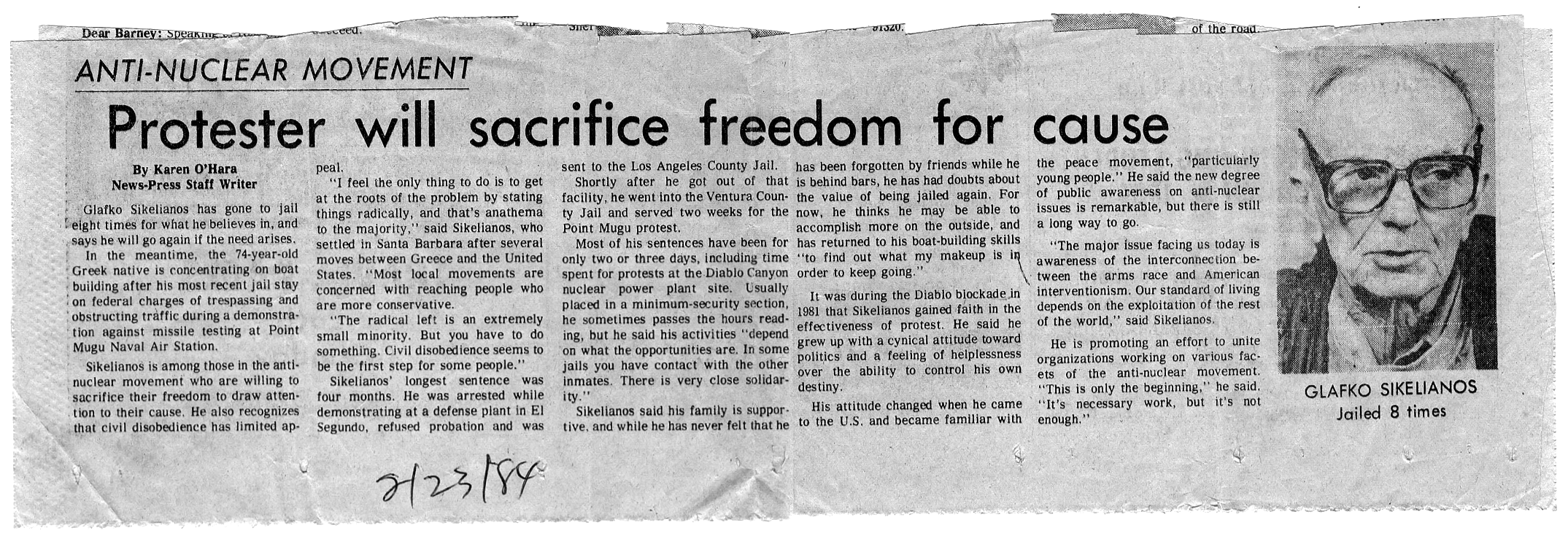 he didn’t mind jail time at all, said he liked the people there
He always reminded me a little of Jacques Cousteau, but Cousteau smiled more.
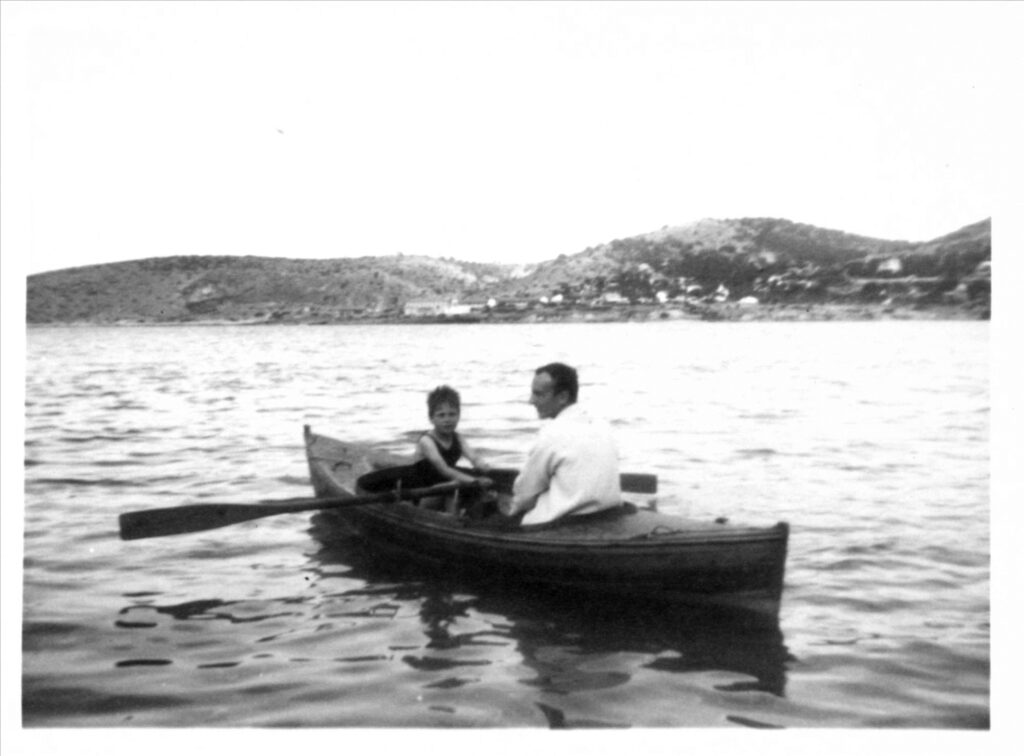
Dreamed
I dreamed of Glafkos last night, wearing a face I have never seen, even in old photographs, but when I woke I could not pull that face toward my face. If I could recognize a different face on that face, with another name…
His is the ancestor face that was the living body I touched that had touched my past, my people archive, a book now closed to me.
They say that whatever way a human face is oriented, whatever light falls on it, a human will recognize it as a human face. Now he is beyond the place where faces matter.
*
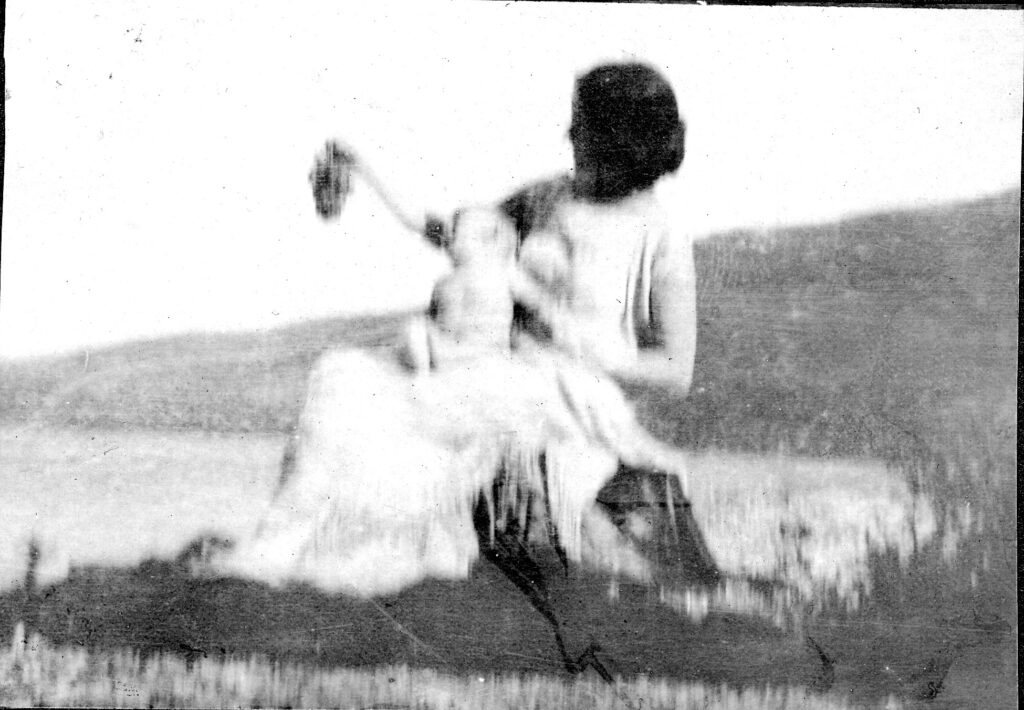
*
Image Credits:
(Image 13) Boissonas photo of Eva and Glaukos, c. 1911 (Benaki Museum Historical Archive, Athens)
Image 14) Clothier, C.R. (1950) Fish Bulletin No. 79. A Key to Some Southern California Fishes Based on Vertebral Characters. UC San Diego : Library—Scripps Digital Collection.
(image 15) Glafkos, 1984. Santa Barbara News-Press article
(image 16) Glafkos & Mark (also called Brastais) in boat, probably Sykiá (Hellenic Literary and Historical Archive, Athens)
Image 17) Eva & Glafkos, likely on Agios Nikolaos (Benaki Museum Historical Archive, Athens)