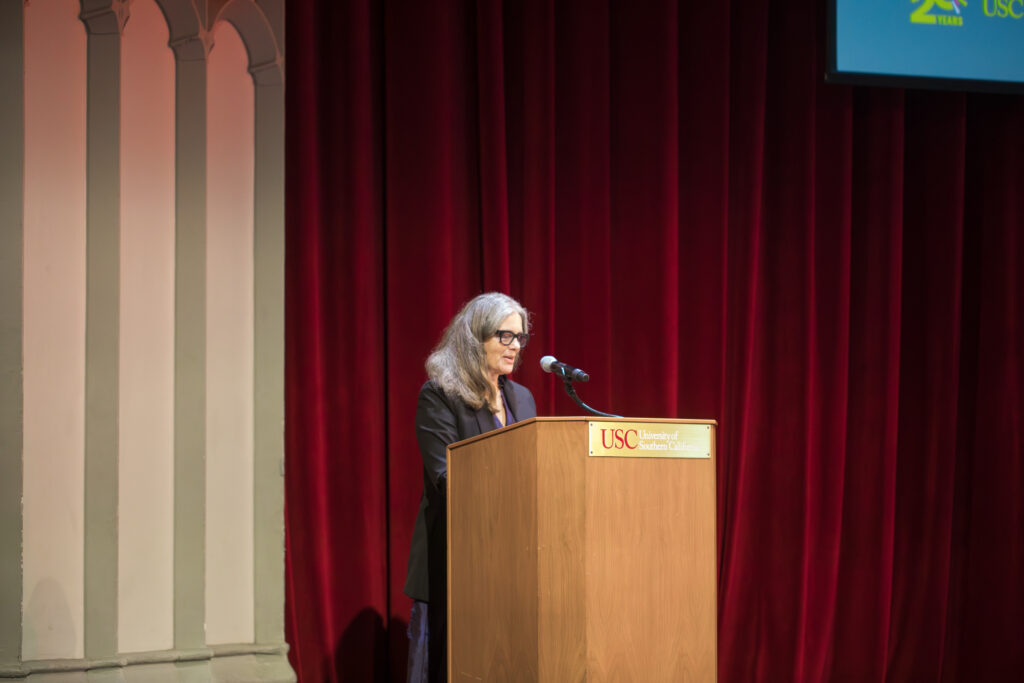
I am honored to accept the 2025 Chowdhury Prize in Literature. I’m deeply grateful to the USC Dornsife College of Letters, Arts and Sciences and to the Chowdhury Foundation. As for the judges, David L. Ulin, Maggie Nelson, Claudia Rankine—I am truly awed that three such extraordinary writers spent time with my work. Time is something we are all short on.
The shortness of time is in fact what I want to talk about tonight. We seem not to have a lot of it left. I’m thinking about the wildfire smoke that fills the sky most summers in the Pacific Northwest; I’m thinking about the fires in Los Angeles last winter. In the face of those fires, and all the other fires, why write? My writing encompasses essay, memoir, and cultural criticism. It’s the last of these that gets closest to my actual work, which is stubbornly hybrid in nature. I have to ask: Is something as awkward and ephemeral sounding as “cultural criticism” any kind of way to face a world that is burning?
And what is it that a critic does, anyway? I find an answer to that question in the Greek root of the word critic: krei-, which means “to sieve.” Well, yes. I am forever putting the world through a sieve. Sifting. When I write, even if I’m building a story or unspooling a narrative, what I am really doing is thinking, and making my own thinking visible to myself, and then to the reader. Sifting for truth.
The folksinger and leftist Pete Seeger told an interviewer that his father had a saying about the truth. His father said, “The truth is a rabbit in a bramble patch. And you can’t lay your hand on it. All you can do is circle around and point, and say, ‘It’s in there somewhere.’” When I write, I am circling the bramble patch. The circling itself is part of the truth. The drama of not knowing the truth, of essaying, of circling, is what I want to get on the page. I want to show my mind being changed. To me, that’s as important, maybe more important, than the occasional glimpse of truth. I don’t trust a writer who leaps to pronouncements and conclusions; I don’t trust myself when I do the same. Only rarely in this life does a real rabbit simply come hurtling out of the brambles. We have learned the dangers of too-easy truths over these past years.
The spectacle of a critic slowly, carefully arriving at her judgment—this is one of the greatest loneliness mitigators I experience as a reader and therefore as a person. When the critic allows me, ushers me, into her thinking, I trust her, I believe her. I am less alone. I become the thinker of her thoughts and it’s an enormous relief.
But what I want from her, and from myself, is more than that. The real truth, the whole truth, requires something that is both humbler and more ambitious. It requires an understanding that our feelings and our thoughts are not our own; they are expressions of cultural, material, and historical forces far beyond our own experience. The best critics understand this. “What feeling do you have that is not tied up with history?” The late writer Randall Kenan asked this question at a 2019 talk at the University of Mississippi, and it’s a line I think about almost every time I sit down to write.
Our feelings and our judgments seem—they feel—sovereign, but they’re tethered to our moment and our circumstance, and to the moments and past circumstances that came before. The best autobiographical prose is neither transcendent nor universal. But it does ask its author to extend her understanding of her life, her feelings, her thoughts past the confines of her own story. To repeat: Feelings, which look immutable, personal, original, are made by history, by culture, by material conditions. Some people are able to express these kinds of connections in fiction or in poetry. For me, and for so many of the writers I love, this dynamic is made most legible, most urgent in what we call, for lack of a better term, critical writing.
I want to tell you a very short story before I finish up. In the summer of 2020, the West was choked with wildfire smoke. That August, a friend and I were sitting on the porch, which as you may recall was the way you saw your friends in the summer of 2020. We were discussing our children, young adults who were (and are) growing increasingly politically radical.
My friend said brusquely, “They’ll grow out of it. Every generation thinks it’s facing the end of the world.”
I had said this very same thing myself, many times. But now I looked at the pink-orange sky, scrimmed by ash. Wasn’t this different, for our kids? I said, “This time it’s really happening, though.”
And I found that I believed it. My belief had changed, my thinking had changed; it was my job to stay with what unfortunately appeared to be a new truth, to not give up even though this new truth was deeply unpleasant and, in fact, in certain ways I myself was responsible for this unpleasant new truth. I’m hugely grateful to my kids and the other young people in my life for helping me look at the truth. It’s my job to understand reality as it changes, and to understand my role in that reality. That’s what criticism really is. It’s my job to sift the truth, to circle the bramble patch. In this burning world, I need the writers I love to think hard and allow me to witness the spectacle of their thinking. I will try my best to do the same.